
Atheist Meets a Child
Posted on May 14, 2026 • 10 minutes • 2066 words
“These great forests, with their seemingly lush trees, endure an eternal conflict beneath their beauty,” the atheist thought as he walked the narrow forest path. “Roots strangling roots, branches stealing sunlight from branches. Perhaps it is struggle itself that blooms into such dense glory.”
He adjusted the satchel hanging from his shoulder and continued through the wilderness with determined steps. “I must extract every drop of nectar from this monk,” he muttered.
Somewhere deeper within the forest, beyond the murmuring waterfall spoken of by villagers in hushed admiration, lived a monk whom many considered enlightened. The atheist had crossed mountains and villages to meet him. “I might finally learn God,” he told himself, the words tasting like irony.
Curiosity carried him forward, though arrogance walked beside it. That arrogance had been earned, at least partially. It was forged in hundreds of successful debates. He had dismantled priests, scholars, wandering sages, and devotees. He wore logic like armour and reason like a blade. To many, he had become a calamity disguised as a man.
Yet hidden beneath his victories was a quieter hunger. He longed for resistance. Not outrage. Not wounded pride masquerading as conviction. He desired not the frantic outrage of the wounded, but a gravity that could actually hold his weight.
“The forest monk by the waterfall is the only person who could quench your thirst for knowledge,” an elderly villager had once told him. But unlike the others who recommended holy men to him out of spite or desperation, the elder had slipped a joyful smile while speaking of the monk. It was the smile of someone who knew a joke the atheist hadn’t heard yet.
That smile had unsettled him, yet it was also deeply comforting. Perhaps, deep within himself, he wished to lose; perhaps he wished to rest. Or perhaps he simply wanted a friend in a foe.
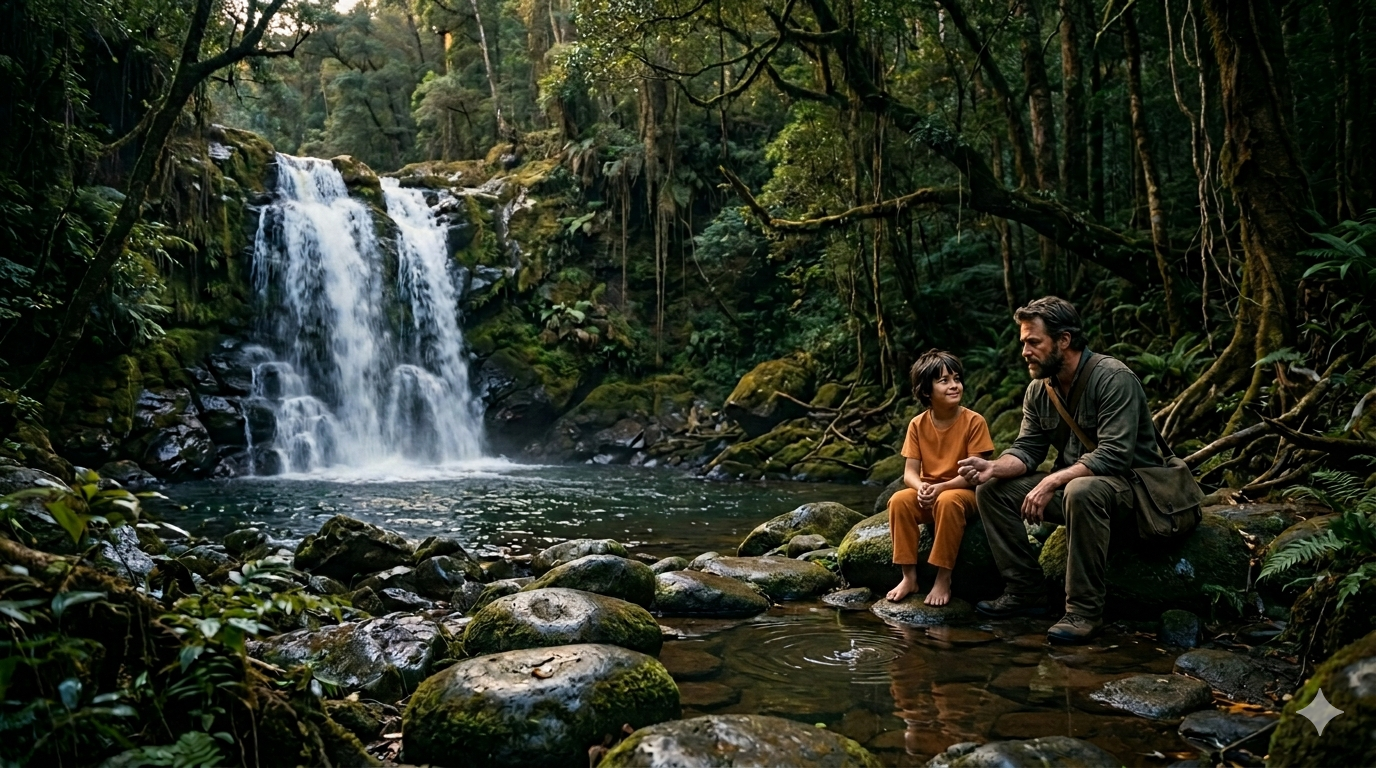
The forest thickened around him. Sunlight leaked through the leaves in fractured rays. The air grew light with the scent of wet bark and moss. Somewhere nearby, water crashed endlessly against stone. At last, he reached the waterfall.
And there he found no weathered sage. No ascetic sitting in lotus. Only a child.
The boy could not have been older than twelve. Barefoot and clothed in simple orange fabric, he wandered lazily beside shallow puddles formed by the waterfall’s spray. He hummed to himself a melody that lacked a beginning or an end, while tossing pebbles into the water, delighting in every ripple as though witnessing creation anew each time.
The atheist stood silently. Surely this was some disciple. Yet there was no monastery. No scriptures. No offerings. No audience. Only the child. The boy noticed him and smiled immediately, with the effortless joy children reserve for birds and strangers.
“You came all this way?” the child asked.
The atheist frowned. “Are you the monk?” he demanded.
The child tilted his head, his eyes reflecting the waterfall. “What is a monk?”
The atheist nearly laughed. What sort of answer was that? “A monk,” he replied, “is a religious teacher. A spiritual head. A guide to truth. Someone who has abandoned worldly desire.”
The child listened carefully while nudging a stone with a dirty toe through the mud. Then he shook his head. “I am not a teacher,” he said, watching a ripple expand. “I do not guide anyone.” Another pebble skipped across the puddle. “I do not know enough to lead others.” Then the child smiled again. “But…” he looked up, and for a second, his eyes seemed older than the forest. “If a monk is someone without desire… perhaps that is me.”
The atheist studied him carefully. The words were strangely heavy for someone so young, yet the child himself seemed untouched by their weight, carrying them like feathers. He spoke as one might speak about clouds or insects. The atheist had spent years among priests who clung to their holiness like kings to crowns. Yet this child wore wisdom accidentally, almost inconveniently.
And while he uttered such dangerous thoughts, he himself seemed aware of the great delusion hidden within all preaching about God. He understood instinctively what scholars often missed: that if God existed as a person above creation, then creation itself had already surpassed Him in wonder.
The atheist stepped closer. “Then answer me directly,” he said. “Where is God?”
The child crouched beside a puddle. He gestured to the mud on his shins, the roaring water, and the atheist’s own furrowed brow. “Everywhere,” he replied. “In this puddle. In this forest. In you. In me.”
The atheist’s expression sharpened instantly. “To see God everywhere,” he said, “is to see Him nowhere. A fish born in water cannot understand water. It never leaves it. It cannot distinguish it from existence itself. If God is everywhere, then His presence becomes meaningless. What impact can He possibly have on man? He is then a background hum, a cosmic irrelevance.”
The child considered this with surprising seriousness, his stick tracing patterns in the silt. Water rushed behind them. “I think…” the child began slowly, “God is also buried inside the heart and is never truly lost.” He pressed a hand against his chest. Birds screamed somewhere high above the trees. “But He is silent.”
For the first time, sadness touched the child’s voice. Not despair. Not grief. Only the soft, borrowed sorrow of others listening for an answer that never fully comes. “To hear Him,” the child continued, “one must not believe in God first. One must believe in oneself. That will show you Him.”
Silence. Even the waterfall seemed suddenly distant. The atheist stared at the child. All his life he had heard the opposite: Believe in God. Trust in God. Submit to God. Yet here, in the middle of a forest, a barefoot child spoke words no priest had ever dared utter. He had spent his life dismantling the “need to believe,” yet here was a child suggesting that the ultimate faith was not a surrender to the sky, but a terrifying confrontation with the self.
And though the atheist resisted it immediately, some hidden part of him understood the depth of what had been said. For he himself had spent his entire life searching for someone greater than himself. Someone sharper. Someone more terrible. Someone capable of containing him.
He finally understood what the village elder had seen. What he sought was not merely God; he sought a worthy adversary. Something vast enough to stand against him. Without such resistance, he himself threatened to lose definition. If nothing existed beyond him, then his own mind would stretch endlessly without border until, like the very God he denied, he dissolved into abstraction. Until he too became shapeless. Until at last he was swallowed by the same void he wished to oppose.
The child, meanwhile, had resumed tossing stones. The atheist spoke quietly now. “If I believe only in myself, then God disappears entirely.”
The child nodded. “And?”
“And then there is no witness to my victories.” The child stopped moving. The atheist looked toward the waterfall. “All stories need a witness. Without a witness, triumph and suffering lose meaning. Achievement becomes nothing more than a private illusion. In that sense… I pity God, child. Unlike me, God has no witness to His story. He is the ultimate isolation.”
The forest wind moved gently through the trees. The child smiled suddenly, and the radiance of it was almost mocking in its sweetness. “To witness your own story is also to judge your own story,” the child said. He stood and brushed dirt from his hands. “And in that power, there is peace. The freedom from being judged by another.”
The atheist frowned. “There is no one to catch us when we fall,” he said quietly, “and no one to applaud when we rise. To be the beginning and the end of your own meaning… doesn’t that terrify you?”
The boy looked up toward the mountain cliffs towering above the trees. “I never told the mountain how tall it is,” he murmured. “To love oneself is to love God.”
The atheist immediately shook his head. “No,” he countered, the sharpness returning to him. “Love, the greatest emotion, requires two. It is a bridge. If God loved Himself, then creation itself may only be God separating Himself from Himself so He could experience otherness to love himself. Even God needed distance in order to love. He had to invent loneliness just to fill it again. In true love, there must be another. If God is everyone, then He is no one.”
The waterfall thundered endlessly behind them. The atheist continued walking slowly beside the child. “And if God loves his creation, all beings equally, why are human beings so rarely noble? Men are not noble, child. Men become cruel under suffering. Misfortune rots goodness. Hunger humiliates virtue. Fear destroys compassion. What kind of divine image is that?”
The boy kicked another pebble into the water. No answer. And strangely, the atheist respected him more for it. Most holy men rushed desperately to defend God. This child did not defend anything. He merely listened, as though truth itself needed patience more than certainty.
The child nudged a fallen fruit with his foot. It had split open against a stone. Rot had already begun at the edges. Ants stormed the sweet flesh, and above them, birds waited on the branches. The child watched excitedly for a moment. “Strange,” he murmured. “This dead thing is feeding many. Why must goodness look clean?”
The atheist opened his mouth, but the child already returned to playing with the mud. The child was not defending mankind at all. He was questioning the atheist’s idea of what divinity should resemble. The atheist measured nobility like a polished diamond: pure, clear, and virtue untouched by contradiction. But the forest itself did not work that way. Life survived through decay. Beauty fed upon ruin. He had known this all along.
He had expected to shatter a fortress, but instead found a mirror. “Mirrors are hard to break. With every shatter, you create a thousand more reflections,” thought the atheist.
They continued to debate in this manner and the atheist felt more at home. Strangely, he was not expecting reluctance, but simple serenity. Hours into discussion seemed to pass like seconds. The forest dimmed into evening gold. At times the child asked questions instead of answering them.
“Why does man fear being alone with himself?” “Why must suffering have purpose?” “What makes victory meaningful?”
And with every question, the atheist revealed more than he intended. He spoke of his hatred for foolishness. He spoke of crowds who believed without thought. He spoke of scholars who hid cowardice beneath sacred language. But eventually, he spoke of himself. Of exhaustion. Of endless argument. Of the terrible loneliness of always standing outside belief.
The child listened to all of it with the same innocent attention he gave to falling leaves. At last, the sky darkened. The waterfall became silver beneath the moon. The child sat upon a smooth stone and asked one final question.
“What did you take from all this?”
The atheist looked toward the forest. For once, he answered without preparing an argument. “I saw wonder,” he said quietly. “The beauty of thought. The terror of existence. The need for meaning. The weakness of men. Their courage, too. I saw misery. Vanity. Love. Fear. Loneliness and Hope.”
The child smiled. “All of those,” he said softly, “are descriptions of God to me.”
The atheist looked at him carefully. The child’s face held no triumph. No hunger to win. Only sincerity. “God is what his creation is,” the child said. “In all his wonders and all his problems.”
The forest fell silent around them. And for the first time in many years, the atheist found himself without a rebuttal. Not defeated. Not convinced. But quiet.
And somewhere deep within that silence, beneath all the arguments and philosophies and wars against heaven, there flickered the faintest possibility that perhaps man’s search for God had never truly been a search for someone above him. Perhaps it had always been the search for the wonders of himself.
The atheist looked into the puddle where the boy threw one last pebble. He saw the reflection of the world that refused to be solved. The ripples widened across the water… and vanished.